

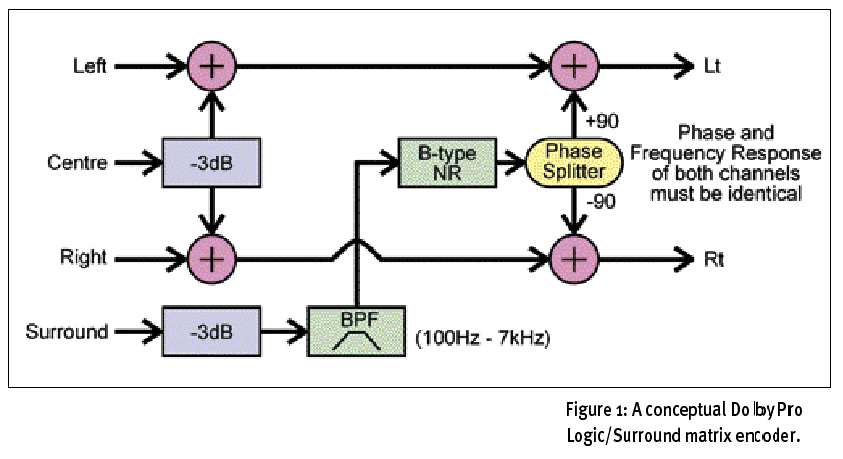
 This impressive understanding of surround sound was likely fueled by the desire to maintain Dolby B in the business. Its brilliance lies in the simplicity of the solution and the application of existing capabilities, widely available at a very affordable price. Every cinema in the world could afford this modification, and obtaining a Dolby certificate was simply great advertising. This solution was also very beneficial for film producers, and the licensing fee became pure profit. With this source of income, it was easy to work diligently on developments for home use, which capitalized on the videotape rental trend. The next step was the introduction of better capabilities for precise bass reproduction and the emergence of A/52, known as Dolby Digital .
 The subwoofer was already unveiled at the Consumer Electronics Show in the fall of 1978. Swedish designer Karl-Erik Stahl presented a brilliant concept featuring a number of innovative solutions. However, no one particularly noticed that this could be crucial for spatial music reproduction and liberation from the amplification of bass frequencies generated by four speakers positioned in corners by the floor and two walls. It was Ray Dolby who created the subwoofer standard, and millions of them are now sold. No such moves are being made with Atmos , as the greatest focus seems to be on calculating revenue from licensing fees

The Eclipsa Audio format , presented in early 2025 at the Consumer Electronics Show , will enable more efficient development of spatial audio hardware. Work on Eclipsa Audio began as the Immersive Audio Model and Format within the Alliance for Open Media, a global business elite . The new format is license-free, but coordination is obviously needed to ensure its usefulness and prevent it from becoming merely a platform for more or less wild concepts.

A big surprise might be the Korean program PotPlayer, which is free and already offers a wide range of audio configuration options. It is developed for Windows. A practical solution for home playback of recordings featuring either Atmos or Eclipse is a setup with four speakers and a shared bass unit. The same applies to 5.1, quadraphonic, and stereo recordings, which the software processes accordingly. Such a speaker system can be optimally arranged for music playback in the room.
 One of the first two speakers for Eclipse Audio functions like a soundbar, but—as the illustration shows—it features drivers designed to interact with the room's side walls. It is the Samsung Music Studio 7. The 3.1.1 designation indicates that it reproduces three front channels and a shared bass channel (like a subwoofer), while the surround channel is directed toward the ceiling.
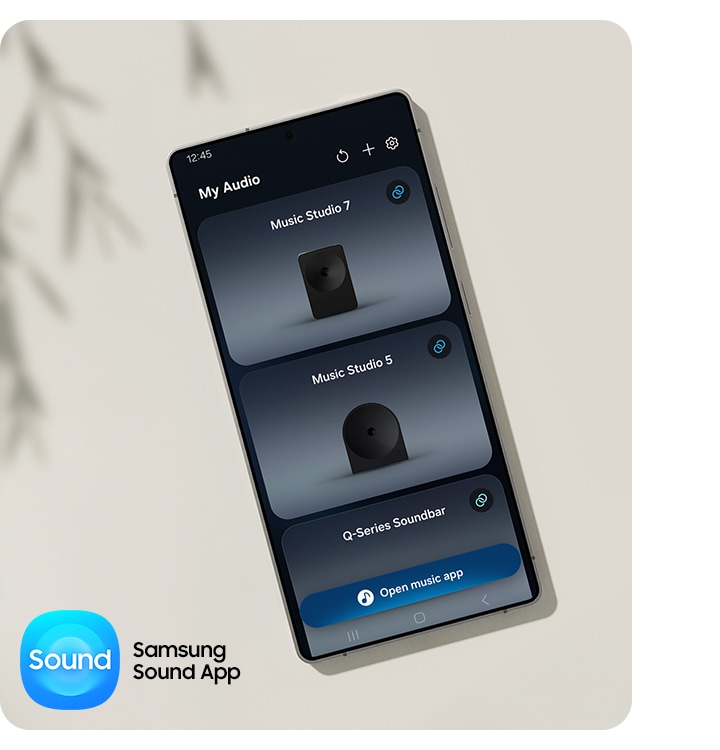
The software allows for the convenient wireless connection of the Music Studio 5, which is a stereo speaker. This creates a 3.1.3 system. This speaker set is a great continuation of the surround sound concept envisioned by Ray Dolby. This speaker setup for the home is far more practical than what was recommended for analog quadraphony. It also ensures music playback without uncontrolled bass amplification in the corners of the room.

Playback in a 3.1.3 configuration delivers an impressive experience with the legendary Pink Floyd recording, remixed in Dolby Atmos. At the Audio Video Show 2025 in Warsaw, a remix of another legendary recording from half a century ago was demonstrated using a 7.4.4 system configuration. That would not fit in most homes. 7.4.4 does not apply to the recording. It emphasizes that four subwoofers were used for playback. Dolby Atmos support was provided by the Marantz AV 10. It features four subwoofer outputs and is designated as a 9.4.6 system.The Blu-ray signal can be configured based on the connected outputs. This may also be possible for a 3.1.3 setup.
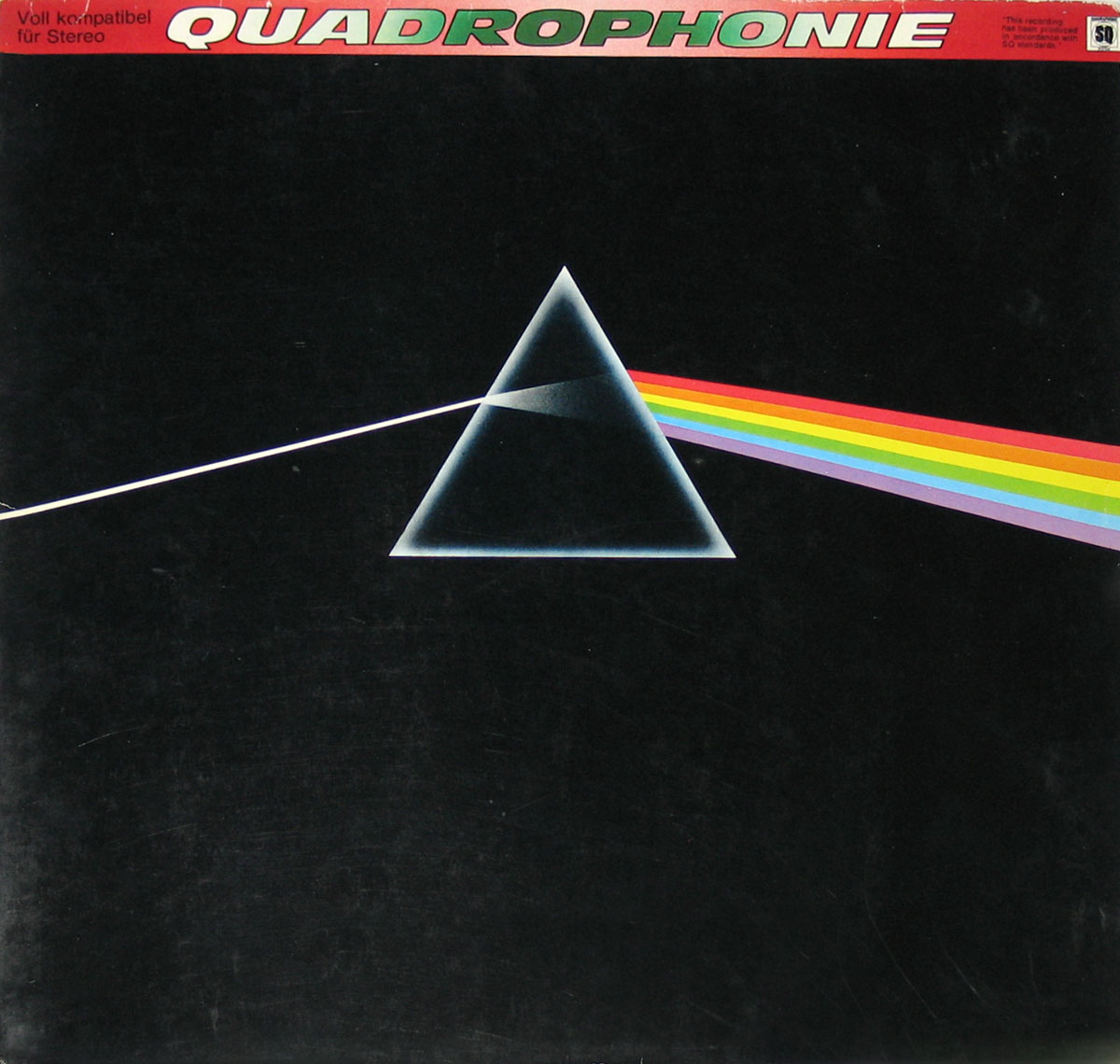
A more home-friendly 3/0/1+LFE configuration in PotPlayer was used to play back a Pink Floyd quadraphonic LP recording. This undecoded SQ recording played via PotPlayer—using this setting with Expand to Center, Surround, and LFE Redirection (180 Hz) enabled—sounded more interesting than when using the classic method for analog quadraphony. The signal from the vinyl was reproduced using an Ortofon MC 20 Super cartridge equipped with a van den Hul stylus.

Audio playback for the front and rear pairs of speakers was handled via analog decoding from the Sansui QS-1. A 4-track recording, made some time ago using a high-quality SQ decoder, was also played. For this recording, the analog signal came from a Dynavector Karat 23R mounted on a tangential tonearm. Both of these Moving Coil phono cartridges ensured minimal phase distortion, which is crucial for the correct decoding of SQ and QS.
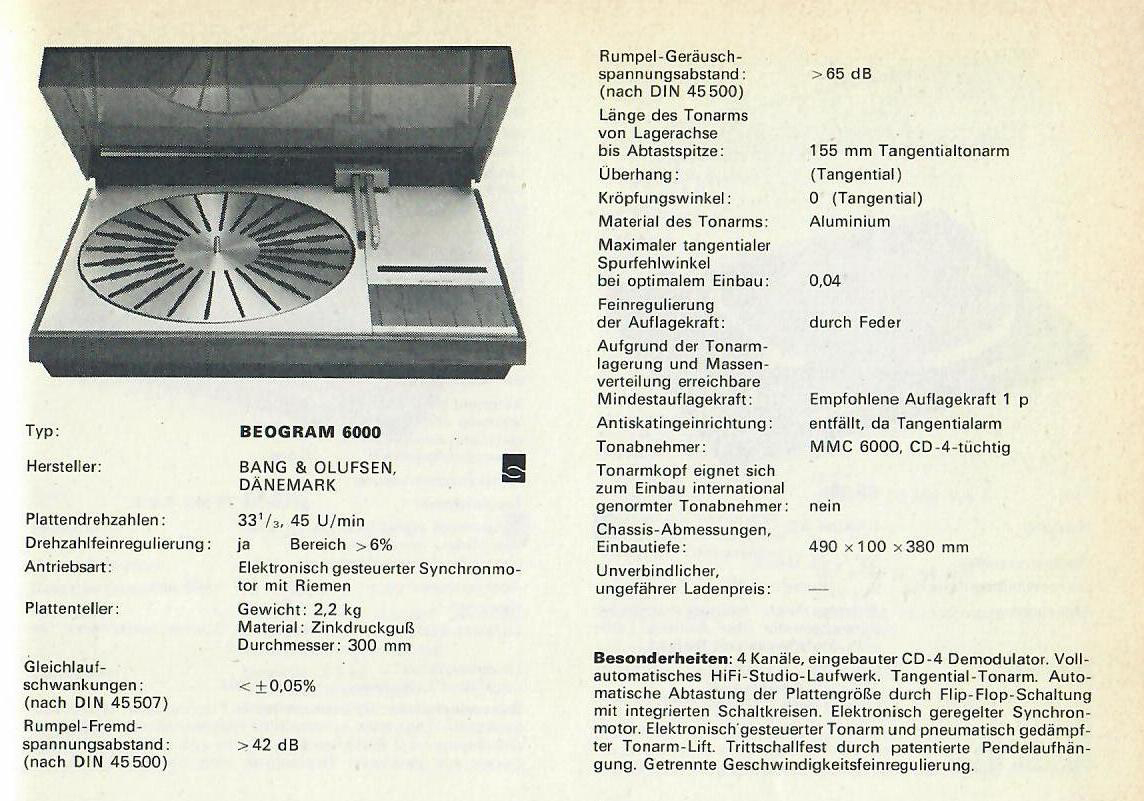
Quadraphonic LPs in the CD-4 format can be ripped most precisely using a Beogram 6000 with Moving Micro-Cross phono cartridge MCC600, as its design allows for the most accurate extraction of the signal—extending up to 45 kHz—from the groove. This results from effectively reducing the moving mass within the vinyl groove, as well as shortening the cable carrying the signal from the Moving Magnet cartridge to the preamplifier's 47 kΩ input.

Eclipsa Audio is free from unnecessary licensing bureaucracy, which will enable the development of software also designed to handle quadraphonic recordings. The same applies to various Dolby formats. Some software will also support 3/0/1+LFE, which is very practical for home use. Ray Dolby introduced a low-frequency cutoff below 100 Hz for the rear channel, which is useful in large cinema auditoriums with large audiences. For home use, it is better to set the filter slightly below 200 Hz.
 The equipment shown above was used during a presentation of the Dolby Atmos system to a wider audience in Warsaw, featuring a Blu-ray disc with a remix of a 50-year-old recording. There were Focal speakers and Naim amplifiers. There was a suitable surface for it. The biggest speaker was the Focsal Grande Utopia Em Evo. The recording was played on the Magnetar UDP900 MKII —winner of the EISA 2025–2026 award best produkct in the home theater disc player category.

Many years ago, the best playback of a Pink Floyd quadraphonic LP was in Stockholm, using the Air Forsell Reference. It was in a spacious room designed for showcasing McIntosh's most expensive equipment. Beveridge speakers stood around the armchair. Playback with this equipment in a smaller room wouldn't be quite as enjoyable. Now, using much more affordable gear and PotPlayer in a smaller room, the experience was surprisingly pleasant—and the upgrade from Eclipse Audio will improve it even further.

Some interesting things can come up with FFmpeg. Released on 2026-06-17 FFmpeg 8.1 "Hoare" already has IAMF: Projection mode Ambisonic Audio Elements muxing and demuxing. Custom configuration of PotPlayer enables efficient use of FFmpeg and IAMF is Eclipsa Audio. From the press release: In 2023, the Alliance for Open Media (AOM) — a global consortium that includes Samsung, Google, Netflix, Meta and other leading companies — officially adopted Immersive Audio Model and Formats (IAMF) as the industry standard for 3D audio. Developed by Samsung and Google, this innovative 3D audio format is currently available to content creators under the brand name Eclipsa Audio.


Technical Specifications Dynavector Karat 23R
ReplyDeleteType Moving Coil
Output voltage 0,2 mV/1 kHz/5 cm/sec
Frequency response 20 ~ 50,000 Hz
Channel balance 1 dB (1 kHz)
Channel separation 20 dB (1 kHz)
Impedance R = 30 ohms, L = 80 micro H
Stylus 0,1 mm x 0,1 mm, line contact naked diamond
Cantilever 0,4 mm x 0,4 mm x 2,5 mm, oblique cut solid ruby
Height 17.5 mm
Weight 5.3 g
Dynavector Karat 23R, the classic MC cartridge featuring the ultra short ruby cantilever and super-elliptical diamond stylus. This is one of Dynavector's most iconic designs - fast, detailed, holographic and musical.Tracks perfectly at 1.5 g. Suspension is healthy and compliant. No channel imbalance, no distortion, no sibilance issues.
Deletehttps://radar.stereonet.com/listing/177947-dynavector-karat-23r-mid-80s-phono-cartridge-w-ruby-cantilever-and
Specifications Ortofon MC20 Super cartridge
ReplyDeleteWeight: 9 gram
Type of Stylus: Van den Hul model II nude
Stylus Tip Radius: r/R 5/70 µm
Equivalent Stylus Tip Mass: 0,49 mg
Frequency Response: 20 - 40,000 Hz =4 -1 dB
Output Voltage at 1 kHz, (5 cm/sec): >0,2 mV
Channel Balance at 1 kHz: >1,0 dB
Channel Separation at 1 kHz: >25 dB
Channel Separation at 15 kHz: >19 dB
Dynamic Compliance, Horizontal/Vertical: 15/15 µm/mN
Vertical Tracking Angle: 20°
Recommended Tracking Force: 18 mN/1,8 g
Tracking Force Range: 16 - 20 mN; 1,6 - 2,0 g
Tracking Ability at 315 Hz (Lateral): >80 µm
Internal Resistance: 3 Ω
Recommended Load Impedance: ≥10 Ω
FIM Distortion: ≤0,8%
From the late 1970s through the mid-1980s, the MC 20 was one of best-selling low output moving coil cartridges and a welcome surprise when compared to the other paltry options available.
Deletehttps://www.tonepublications.com/analog/ortofon-mc-20-cartridge/
The Ortofon MC20 Super costs around $350, and features a van den Hul type 2 stylus tip.
Deletehttps://www.stereonet.com/reviews/review-ortofon-mc20-super-phono-cartridge
B&O's quadraphonic suite was expensive, costing 'a little over £1000' when introduced. The complete outfit included a specially adapted version of the firm's famous tangential tracking turntable [HFN June '14] and four Beovox P45 Uni-Phase 'panel' loudspeakers, which were designed to be mounted on a wall.
ReplyDeleteThe system was designed to play both Sony/CBS SQ and Victor CD4 records, and also be compatible with a four-channel tape recorder.
https://www.hifinews.com/content/bo-beomaster-6000-4ch
advanced stylus shapes appeared following the same goal of increasing contact surface, improving on the Shibata. Chronologically: "Hughes" Shibata variant (1975), "Ogura" (1978), Van den Hul (1982). Such a stylus may be marketed as "Hyperelliptical" (Shure), "Alliptic", "Fine Line" (Ortofon), "Line contact" (Audio Technica), "Polyhedron", "LAC", or "Stereohedron" (Stanton).
ReplyDeletehttps://en.wikipedia.org/wiki/Phonograph#Pickup_systems
Beveridge Flashback! 08-29-2024
ReplyDeletehttps://www.audionirvana.org/forum/the-audio-vault/vintage-audio-gear/188205-beveridge-flashback
Eclipsa Audio: everything you need to know about Samsung’s new Dolby Atmos rival
ReplyDeleteBy John Archer, Published 21 March 2025
https://www.whathifi.com/av/eclipsa-audio-everything-you-need-to-know-about-samsungs-new-dolby-atmos-rival
The Forsell Air Reference is a legendary, ultra-rare high-end turntable designed by Swedish engineer Stefan Forsell. It is famous for using compressed air to completely isolate both the platter and the tonearm from mechanical friction and vibrations.
ReplyDeleteThats right, the platter sits on a cushion of air providing the least amount of friction possible. A light puff of air will get this baby spinning. Same for the tonearm, it has a hollow tube with very fine holes which allow it to slide laterally with almost no effort, much like an air hockey table.
We just finished this exclusive turntable build and is ready for a new home. Took several years to complete but the results are spectacular and well worth the time investment.
All pumps and devices are now housed in a custom aluminum enclosure which is insulated to eliminate noise or vibration. It is now barely perceivable that the two pumps are running . Also housed inside are the regulators, filters and accumulators. All items are brand new except for the regulator which is a laboratory grade Peerless unit.
The unit connects to the turnable through a 5 pin connector and two hoses about 8 feet length for flexible placement. Power to the pumps is controlled on the front panel or on the side of the turntable for convenience.
A quick change of the pulley position allows a change from 33 to 45 RPMs.
The plinth, drive, and tonearm are all and working perfectly and the tangential tonearm makes setup and calibration a breeze.
This new package is a nice upgrade from the original factory setup which was messy and confusing.
The table itself is in wonderful condition with deep scratches or damage. The black gloss acrylic finish is super clean although there are some signs of wear since gloss plexiglass is so hard to keep perfect.
The 24k gold plating on the tonearm is intact and looks stunning. The air bearings work smoothly, and the platter spins like what seems to be forever with the motor removed.
The 'table is numbered with a gold plaque stating it is # 54 / 115.
There is no phono cartridge included with this listing but you can choose from our menu if youd like one installed and calibrated.
https://skyfiaudio.com/products/forsell-air-reference-tangential-air-bearing-turntable-super-rare?srsltid=AU7gw4VqbWmgMIURJKshLzcyH3uWll6zzNAVo_6NAFvYiaQ3Tg1dZI3M
I never met Engineer Stefan, but the project was led by my colleague Peter Forsell—a surgeon—and without his precise calibration of the vacuum pump, this turntable would not be so perfect.
DeleteMusic Studio 5 draws inspiration from classic audio design while introducing a unique design language that gives it a timeless presence. It captures the inherent elegance of an objet d’art and presents a shape that is both novel and pure—enough to signal a new era of audio device design, yet subtle enough to blend seamlessly with various spaces and uses. Its refined yet unique design allows it to communicate a clear and powerful form-driven message to the user.
ReplyDeletehttps://ifdesign.com/en/winner-ranking/project/music-studio-5/758509
The Samsung Music Studio 7 is the world’s first Wi-Fi speaker with a 3D acoustic sound structure, supporting both Eclipsa Audio and Dolby Atmos. Built with patented Immersive Waveguide technology and five advanced speakers, it delivers true surround sound from one single, compact device. This groundbreaking technology is encased in a unique, eye-catching design for a form factor unlike any product in its category. The speaker can be connected wirelessly to Samsung TVs and up to four other speakers simultaneously via Samsung Q-Symphony technology—the only platform capable of wirelessly connecting five audio devices. The result is a true cinema-like experience at home, reaching an incredible 15.0.5-channel layout.
ReplyDeletehttps://www.ces.tech/ces-innovation-awards/2026/samsung-music-studio-7/
ReplyDeleteThe Lamb 50th Anniversary Super Deluxe Edition
26th September, 2025
The 50th Anniversary Super Deluxe Edition of The Lamb Lies Down on Broadway is released today.
Available as a 4CD + Blu-ray Audio or 5LP + Blu-ray Audio box set and, also, on Digital and Dolby Atmos formats, this is the album’s definitive compendium and has been overseen by all the members of the band.
https://petergabriel.com/news/the-lamb-50th-anniversary-super-deluxe-edition/
https://en.wikipedia.org/wiki/The_Lamb_Lies_Down_on_Broadway
Delete