Tokyo Electro Acoustic Company had some interesting plans with NXT when digital recordings came along

The inexpensive set shown in the illustration above can reproduce music well if the signal to it is not distorted and the electro-acoustic transducer in the subwoofer is aimed directly at the listener at the height of the speakers. This is largely due to the NXT speakers used in this set. Wikipedia mentions the disadvantages of these speakers: Low directivity and slow fading may lessen stereophonic sound impression. Still, listening from an off-center position gives some imaging of phantom sources as the other speaker can be heard with its full spectrum, but with extra delay due to the listeners local position.This opinion can be caused by many factors, and the source is very important here, i.e. what was recorded and finally saved, most likely while listening to other loudspeakers. It is also unknown under what conditions this description was born and what it was like in the original before it was adopted in the Wikipedia entry.

In the 1970s, many musicians worked at home with a TEAC A-3340 tape recorder. One of them, out of sentimental impulse, bought two such NXT systems to listen to quadraphonic tapes. He has four-channel tapes that were sold decades ago and may still be available at a high price today. He also has his own four-channel copies, which he once copied from quadraphonic records. Playing records was irritating for him because of the booming bass. This was most likely due to acoustic feedback, which didn't occur with tapes. With the new equipment, the bass again irritated him, even though he was playing back recordings from tapes.
 A simple Yamaha A 320 amplifier provided a better solution. Two flat-panel NTX speakers were connected to it. Installation was child's play. The front channels of the A-3340 tape recorder were connected to the TD-X300i set, and the rear channels to the A-320 amplifier. The subwoofer and front NTX speakers were at the same level, and the rear speakers were more or less the same. The musician was pleasantly surprised. Another interesting connection was to use a second X300i in the front, but only its subwoofer. The signal from the headphone output of one set was fed to the input of the other. Both subwoofers were placed vertically, with the drivers at the same level as the NTX. The musician summarized this acrobatic feat: the bass was exaggerated, but not muddled. Turning on a soldering iron and opening the sets' enclosures could have produced even more interesting results. The A-320 might even have been superfluous. Low-cost resistors can make the bass even more reliably reproduced and the music more satisfying.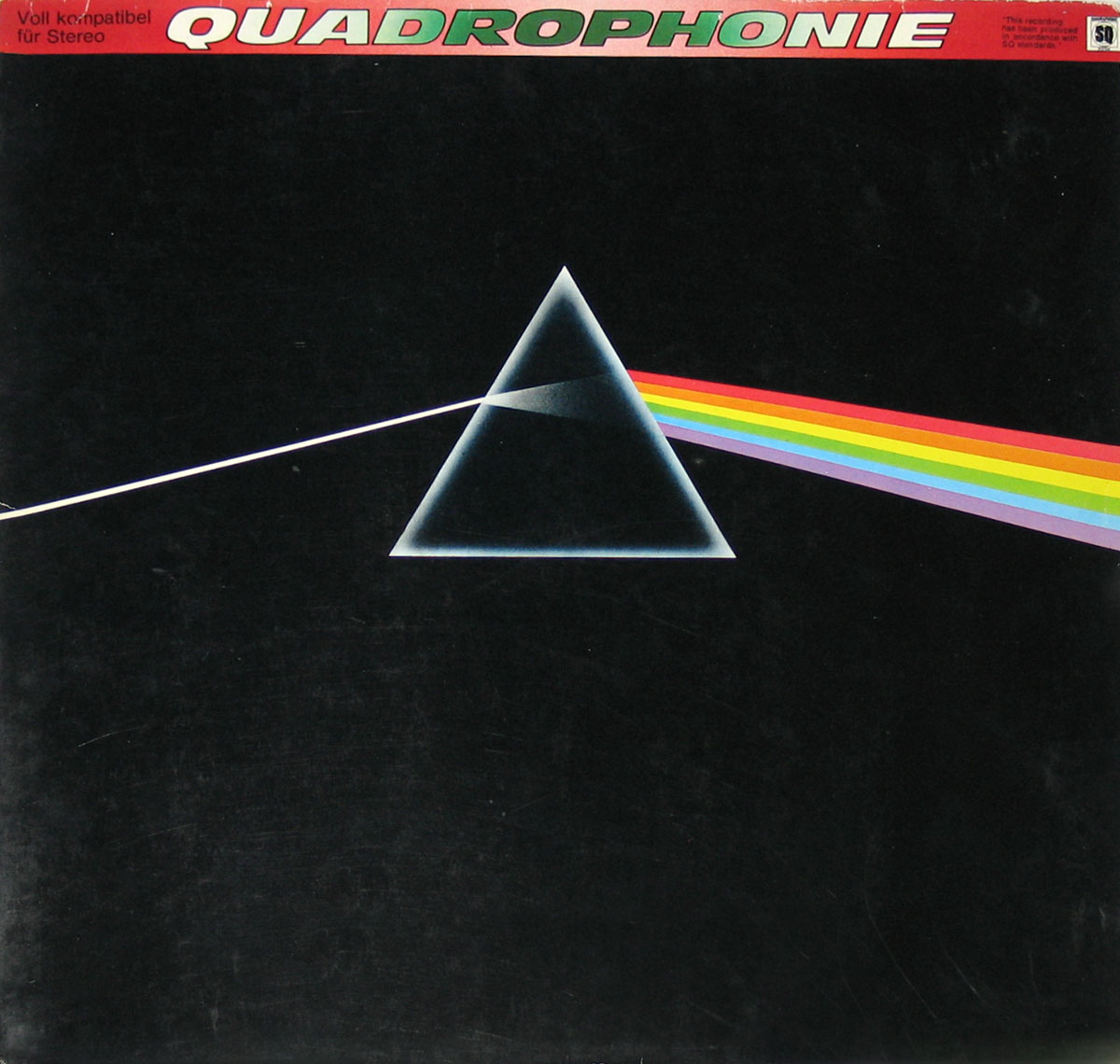
The configuration with 4 NXTs and one subwoofer worked very well when playing music from a 4-channel tape which was copied from the SQ record "The Dark Side Of The Moon". Not everyone might think so, because the Pink Floyd album is so well-known that many people remember how it sounded with their playback equipment, so they may have their own opinion. "Stereo Quadraphonic" is a matrix 4-channel quadraphonic sound system for vinyl LP records. It was introduced by CBS Records (known in the United States and Canada as Columbia Records) in 1971. The SQ encoding is based on the work by Peter Scheiber and further developed by Benjamin Bauer. His basic formula used 90 degree phase shift circuitry to enable enhanced 4-2-4 matrix systems to be developed
 On well-calibrated equipment, playing a 5.1 remix of a quadraphonic recording released on SACD is undoubtedly an experience. The remix's quality is undeniably guaranteed by James K.A. Guthrie (born 14 November 1953 in London) is a British
sound engineer and record producer, best known for his work with the
band Pink Floyd, having served as a producer and engineer for the band
since 1978. Equally important is, of course, Alan Presons, about whom it is mentioned: his real ongoing claim to fame was his engineering work on Pink
Floyd's Dark Side Of The Moon (1973) which earned him his first Grammy
nomination. The remix was certainly not a simple commission for them, but a personal testament to the possibilities of newer technologies. The 30th-anniversary edition won four Surround Music Awards in 2003,and sold more than 800,000 copies.
On well-calibrated equipment, playing a 5.1 remix of a quadraphonic recording released on SACD is undoubtedly an experience. The remix's quality is undeniably guaranteed by James K.A. Guthrie (born 14 November 1953 in London) is a British
sound engineer and record producer, best known for his work with the
band Pink Floyd, having served as a producer and engineer for the band
since 1978. Equally important is, of course, Alan Presons, about whom it is mentioned: his real ongoing claim to fame was his engineering work on Pink
Floyd's Dark Side Of The Moon (1973) which earned him his first Grammy
nomination. The remix was certainly not a simple commission for them, but a personal testament to the possibilities of newer technologies. The 30th-anniversary edition won four Surround Music Awards in 2003,and sold more than 800,000 copies.
Unique configurations was made for the SiestaTime Club with a stage sound system and Digital Audio Broadcasting. In the Sierakowski Manor House from 1714, people sitting in deckchairs on the sand in the garden of an artistic café could listen to world music presented in a radio program that has been broadcast in Poland for over 30 years. When it rained, the PA with subwoofer och satellites has to be moved indoors, where it looks unattractive. A TEAC set with NXT and DAB would have been a much better solution. There were a few models available, like the MC-DX40DAB. Now, SiestaTime Club can stream at 256kbps, and while TEAC doesn't offer an option for this with NXT speakers, a model with just an FM radio, like the TD-X300i, can be connected analogue to a PC and optimally configured to minimize clippings after 32-bit float/192kHz D/A conversion.

In Soud Korea Genelec presents its speakers with the unique ability to optimally calibrate them in a 5.1 setting. This is particularly important because the Korean chaebol is the initiator of competition for Dolby Atmos. More A historic launch for Eclipsa Audio in Las Vegas will change a lot. However, there are many indications that the NXT loudspeakres and subwoofer offer better options in terms of surround sound, and the newer offering with the Immersive Audio Model & Format, which has been shortened to Eclipsa Audio, may be adapted to this more efficiently.
The NXT is a broadband solution, so the unique Genelec features are unnecessary. Windows has had a built-in calibration system for years, which also supports 5.1, and will work well with a subwoofer and 5 pcs NXT, but purchasing those isn't easy. Microsoft is one of many members of the Alliance for Open Media, which is responsible for the development of the IAMF.
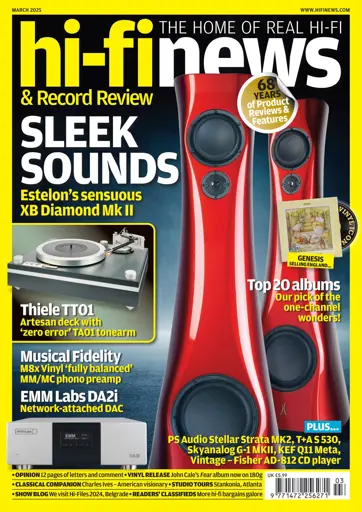

Quad has been part of the NXT group since 1996, and back in 1957 it offered an electrostatic loudspeaker that allowed people to enjoy spatial sound from mono recordings.
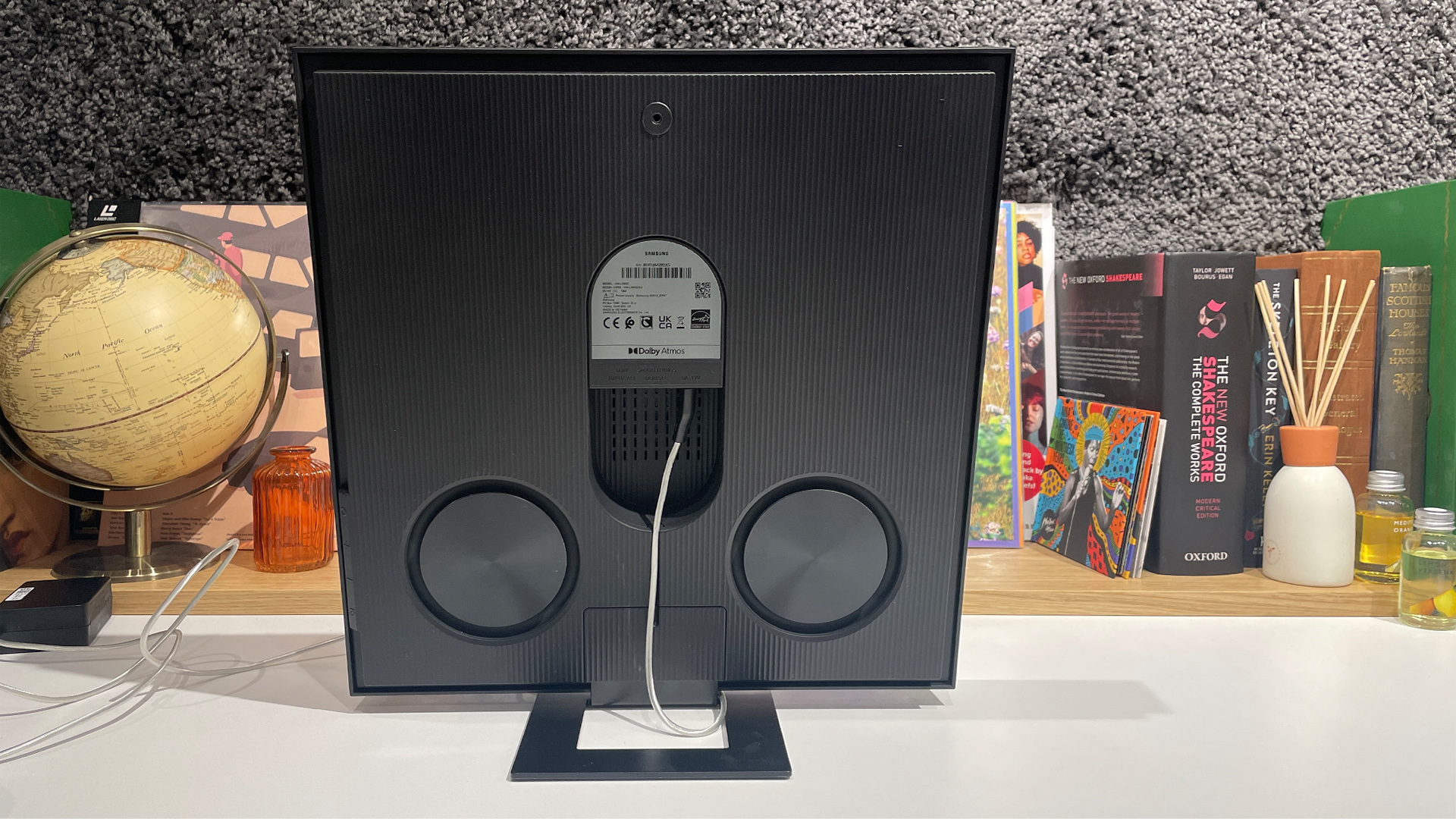 An interesting solution, and at a relatively low price, may be also the Samsung Music Frame HW-LS60D/ZF. The manufacturer has offered this rather unusual speaker in the wireless speaker category. It also suggests purchasing two, one for the left and one for the right, but the front and rear option may be more appealing. It just needs the right software. The one that is already has a wide range of possibilities, but it can be even better in terms of sound quality.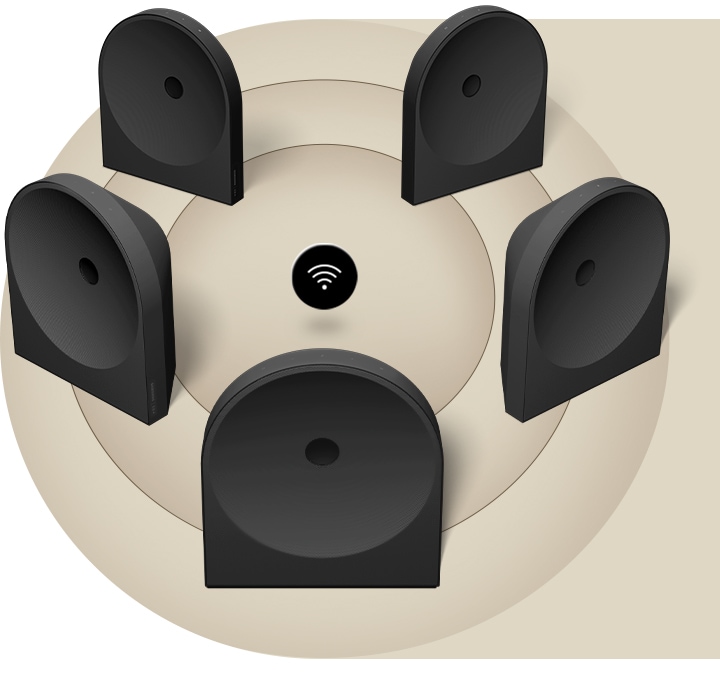
Samsung unveiled its new line of wireless speakers at the beginning of 2026 in Las Vegas, but the five don't seem very practical for home use. Nevertheless, it confirms that the perception of how we listen to music at home is changing. The 2 Music Studio 5 speakers shown in the image above, together with a subwoofer connected to them and recordings saved with Eclipsa Audio technology, will provide a wonderful experience

This Korean chaebol has also owned the legendary American brand for several years, now widely associated with wireless speakers worldwide. Expect new solutions in this lineup as well.
 It's no surprise that the prestigious Danish brand B&O has an interesting lineup of wireless speakers. They've implemented their latest solution, Mozart, which focuses on extensive upgrade options. Less well-known is that in 2017, Bang & Olufsen entered into close partnerships with two Korean giants: in August with LG, and in May through Harman with Samsung.
drawing by Per Oscar Dahlberg
Benjamin's psychoacoustic lab is
constantly testing and implementing possibilities for optimal music
playback using new technical solutions with the computing potential of
computers and open structures. PC4uMusicis the main project and this blog is just a notebook focused on technical possibilities, not the beauty of words.

Of Pink Floyd's The Dark Side of the Moon, engineer Alan Parsons recalled: "It was certainly the band's intention, when we recorded the album, to mix in quad. All the effects on 'Money' and other tracks were recorded on four-track, so they could be heard in true quad on the final record… But by the time the mix stage was upon us, quad hadn't really taken off as a medium in the way it was expected to, so it was a little bit of an anticlimax. Then, as we know, the whole thing died a death".[
ReplyDeletehttps://en.wikipedia.org/wiki/Stereo_Quadraphonic
Samsung Music Frame review
ReplyDeleteIs it a photo frame? It is a speaker? It’s both - but is it any good?
By What Hi-Fi? Published 15 November 2024
https://www.whathifi.com/reviews/samsung-music-frame
Hands on: Genelec 8381A review
ReplyDelete£60k five-way active studio monitors that combine sophistication and savagery
By Ketan Bharadia. Published 19 July 2024
https://www.whathifi.com/reviews/hands-on-genelec-8381a-review
Marcel Schechter talks about the Genelec Loudspeaker Manager
Deletehttps://bestofhighend.com/marcel-schechter-talks-about-the-genelec-loudspeaker-manager-2/
Genelec GLM 4.2
DeleteSpeaker Management Software
By Sam Inglis. Published July 2023
https://www.soundonsound.com/reviews/genelec-glm-42
Since 2006, GLM software has offered precise calibration and control of our SAM Monitoring systems to minimise unwanted room influences and improve workflow, helping you mix confidently in any space. GRADE Room Acoustic Reports further empower you to understand and improve your studio's performance.
Deletehttps://www.genelec.com/glm
Samsung has released new lifestyle speakers for the home. The Music Studio 5 is a unique looking unit designed by French artist Erwan Bouroullec and comes in black (LS50H) and white (LS51H) with power adaptor cables in the same colour pairing. It retails in Singapore at S$349, and $659 for 2 units.
ReplyDeletehttps://musicphotolife.com/2026/05/samsung-music-studio-5-speaker-review/
There are a lot of smart speakers in the $300 range out there. Some share a soft cylindrical shape, some veer into rectangular and triangular forms. The Samsung Music Studio 5 caught my eye with its unique but familiar circular arch form — the pleasing result of a collaboration with designer Erwan Bouroullec, who takes the effects that everyday objects have on our day-to-day lives very seriously.
Deletehttps://www.crutchfield.com/S-HUJyX2uXot4/learn/samsung-music-studio-5-review.html
Samsung's new Music Studio wireless speakers have a touch of Ikea about them
DeleteBy Joe Svetlik. Published 6 January 2026
https://www.whathifi.com/speakers/wireless-speakers/samsungs-new-music-studio-wireless-speakers-have-a-touch-of-ikea-about-them
Teac A-3440
ReplyDelete4 Channel Multitrack Tape Deck
by Martin Sheehan
Article from Home & Studio Recording, May 1985
https://www.muzines.co.uk/articles/teac-a-3440/6375
nxttechnologyreview.01
ReplyDeletehttps://simeoncanada.com/wp-content/uploads/2018/12/NXT-Technology-Review.pdf
NXT Technology
DeleteWhen a Little Chaos is Good For You
by Henry Azima
https://loudmagnet.com/html/pdf/NXT%20Technology.pdf
The Quad Electrostatic Loudspeaker (ESL) is a legendary audio design closely linked with historic monitoring standards, though Quad amplifiers rather than the electrostatic speakers themselves were primarily adopted as BBC reference gear. While Quad's early valve amplifiers like the QA12/P and Quad II found a permanent home inside BBC control rooms, the ESL series revolutionized high-fidelity home and studio listening as the world's first full-range electrostatic loudspeaker
ReplyDeleteDesign and HistoryLaunch Year: Introduced in 1957 as the Quad ESL (later called the ESL-57) by Quad Electroacoustics.Core Principle: Uses an ultra-thin electrically charged Mylar membrane suspended between two metal stator grids to move air cleanly.Evolution: Progressed through major milestones like the concentric-ring ESL-63 and modern iterations including the ESL-X series
Performance TraitsMidrange Clarity: Famed for an unmatched, hyper-realistic reproduction of the human voice and acoustic instruments.Low Distortion: Delivers exceptionally clean sound due to the feather-light weight of the moving membrane.Placement Needs: Functions as an open dipole radiator, requiring careful spacing away from back walls for optimal bass and soundstaging.If you'd like to continue, let me know if you want to focus on:The original ESL-57 versus later models How Quad amplifiers matched with BBC monitor requirementsTechnical details on electrostatic voltage panels
Swedish Radio famously used Quad electrostatic loudspeakers (specifically the original Quad ESL, also known as ESL-57) alongside Quad power amplifiers like the Quad II as reference and control room monitors during the 1960s, 70s, and 80s.
DeleteHistorical Use at Sveriges Radio
Reference Monitoring: Utilized for critical broadcast evaluation and acoustic testing due to ultra-low distortion and transparent midrange fidelity.
Matched Electronics: Frequently paired with modified broadcast versions of the Quad II tube amplifiers or later solid-state units like the Quad 405 and control preamplifiers.
Custom Modifications: Units utilized by Swedish Radio often featured specialized internal wiring, input transformers, or added network filters tailored for broadcast studio requirements
Technical Characteristics of the Quad ESL
Design: World's first full-range production electrostatic loudspeaker, launched in 1957 by British manufacturer Quad.
Operation: Uses an ultra-thin electrically charged plastic membrane suspended between two metal stators.
Legacy: Celebrated for unmatched vocal realism and speed, though demanding in placement and amplifier matching