
PC4uMusic configurations allow for the processing of digital recordings with a precision of 32 bit float / 192 kHz into an analog signal. The PC can digitally convert the recording for playback on four speakers with high accuracy and even extract a bass channel. However, the reference solution for surround sound became 4 active Tannoy Gold studio monitors with coaxial electro-acoustic transducers.
The small size of the
Tannoy Gold 5
meant they seemed best as a reference for playing music from 3 speakers
in the front and one in the rear. These speakers have coaxial electroacoustic transducers, which are marketed under the name
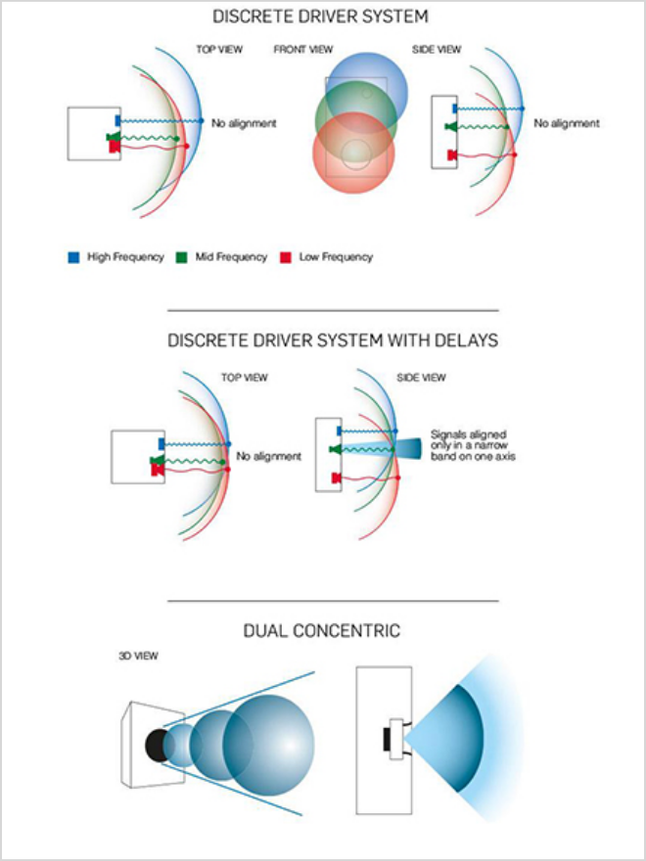
Dual Concentric. This manufacturer has many years of experience with coaxial drivers. Wikipedia even lists:
the term "tannoy" as being used in British English for any public-address system. An alternative, due to its good
price, may be the slightly larger
Gold 7, which has a 6.5-inch driver and a 300-watt amplifier. 4 pieces of even larger
Gold 8 seem to be too much at home. All the more so because the
Tannoy offers
bass-reflex, with side effects that are amplified by four loudspeakers.
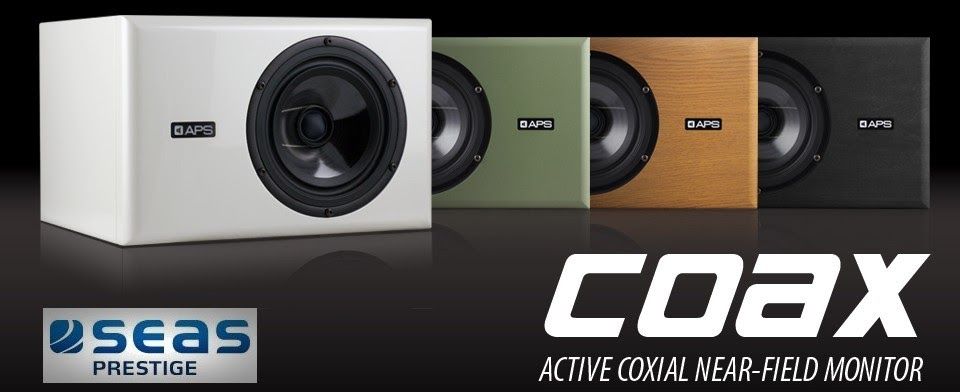
A more interesting solution is a 6.5-inch coaxial driver from the Norwegian company
SEAS, mounted in a
sealed enclosure. This is the offer with the Polish
APS Coax studio monitors. They received
very positive reviews in Sound on Sound tests. With them, the advantages of a sealed enclosure are easily audible.

The Japanese
Technics SB-R100 speakers are also very interesting. They look like 10-inch three-way speakers. However, they are 7-inch two-way coaxial speakers with
a passive radiator. This design also avoids the disadvantages of bass reflex. They are also flat and fit elegantly against the wall. Completely flat membranes also ensure more precise music reproduction than traditional ones. However, they are not active, so an external amplifier is required, but that is not a problem. It's much harder to buy these speakers. Manufactured 4 decades ago, they may now have also a problem in case of any damage.

It is even more difficult to buy
the SB-R200 , whose acoustic driver has a diameter of more than 12 inches, or more precisely 32 cm. After appropriate signal conversion, such a loudspeaker could be only a central one and three smaller ones on the sides in a closed housing, i.e. without a passive membrane. This could have been a beautiful reference, but unfortunately there is no such speaker set or optimal software for it.

Now Technics offers active bass-reflex speakers SC-CX700 with 6 inch coaxial transducer. They can be an alternative to Tannoy, but they are in a different price class, which is especially important with 4 speakers. What is interesting about them is that they use a 1-bit digital signal delivered to the built-in DSP. This could greatly improve wireless connections. Now the wired connection is with 24 bit/192 kHz and the wireless with half the frequency. There is a review of these speakers in Whats Hi-Fi?

The generously awarded
KEF LS50 also offers wireless connectivity, but the possibilities for development are probably limited. The manufacturer is now looking for cheaper solutions with lower resolution. British
KEF has a long tradition with loudspeakers, but not with electronics. The current owner of this brand also does not have an appropriate tradition of self-development. In comparison with the
Technics SC-CX700, the bass reflex port in
KEF speakers is also disadvantageous because it is located at the back, which causes distortions that are difficult to reduce at home.

Technics has its own integrated circuits for
1-bit technology, which are used in a wide variety of equipment manufactured by this company. Their optimal use strengthens their position on the market, and is even necessary to avoid losing their position on the market. One of the competitors is a Korean manufacturer that, together with global giants,
introduces Eclipsa Audio. The Japanese manufacturer will certainly use this opportunity to adapt its electronics to this.
The Technics SB-R200 could have been a great addition to the PC4uMusic presentation at AmberExpo. Hanged on the wall, they could have better emphasized the slogan Music is not an office application. Then there would be nothing on the floor. The artistic vision of the PC without a case could have been better exposed.
 Yet another artistic vision could have been provided by Technics SST-1 from 1988. It is
 a twin load horn speaker system that achieved reproduction ability
with higher efficiency and lower distortion. This system is part of the
permanent collection of the
Museum of Modern Art in New York.
These speakers are the height of a human torso. Now this design could reproduce music even better with a coaxial driver and built-in electronics with DSP support, as in the SC-CX700. It is also always possible to build a speaker with a coaxial driver yourself and computer-controlled milling machines are very helpful in this regard. However, selecting the appropriate electroacoustic transducer for this purpose is difficult and such a design will not be practical in a home environment, where music is to be played from three speakers at the front and one at the rear.
There is no problem in using a PC in a transparent case, as shown at the stand at AmberExpo. The motherboard had a galvanically separated audio section. The audio signal was output analogue with gold-plated RCA connectors and an Intel HD Audio adapter. Alternatively, the housing can be made of wood, as in elegant Hi-End Audio equipment, which was also shown at the stand. Perhaps Technics will offer drivers for PC to wirelessly connect 4 active speakers and use Eclipsa Audio with SC-CX700. The PC desktop case can already be made to match the appearance of these Technics speakers.
Benjamin's psychoacoustic lab is
constantly testing and implementing possibilities for optimal music
playback using new technical solutions with the computing potential of
computers and open structures. PC4uMusicis the main project and this blog is just a notebook focused on technical possibilities, not the beauty of words. 
PC4uMusic 3-language (se; en; pl) Facebook profile>>>


DSP in SC-CX700 is also in Network CD Receiver & Digital Amplifier SA-C600
ReplyDeletehttps://www.technics.com/au/products/hifi-components-speakers/sa-c600.html
a test SA-C600 with the SB-R200 could be interesting
DeleteSB-R100 were for the SA-R100 set.
ReplyDeletehttps://blogger.googleusercontent.com/img/b/R29vZ2xl/AVvXsEjA-owA7nDL3ngEVRaMgjyfoEHnU7uYJC81wGPFxnkQC0ckf9CTZ1CC8ijA7wkRr6M4p0fnXimEZKRMiHzbyoPoml4ieT6uEFlENxh3VYfMhRwk41Bv_YJEtdSiNKuzacFn_JRiTkia2KF0zXPH5Iqkt5azRcP482WPe7e0KW5wbkHQogsJpEKBH-L9/s16000-rw/sar100.jpg
https://www.hifiengine.com/manual_library/technics/sa-r100.shtml
DeleteThis is a 1984 Flat Panel wall mountable amplifier, tuner and cassette deck; it also has the original remote control which hides behind the door- see images.
Delete- The AM/FM tuner has 8 presets plus volume, DC/AUX inputs
- LED volume level meter and lights up.
- Record levels, bass, treble, balance have been placed behind the remote control.
- The Antenna sits on the top of the unit and can be removed easily.
https://www.stereonet.com/forums/topic/296290-fs-rare-technics-sa-r100-stereo-amfm-receiver-cassette-without-flat-panel-coaxial-speakers/
The Technics SB-AFP1000 at 1988 was a superlative flat-panel speaker that used twin cabinets based on a unique acoustic theory. This speaker achieved highly faithful sound reproduction and was used by the Vienna State Opera.
ReplyDeletehttps://www.youtube.com/watch?v=Z14Ea35OUdU
DeleteDUPLEX was the trade name given by Altec Lansing to its line of coaxial loudspeakers, beginning with the first model 601 in 1943.
ReplyDeletehttps://en.wikipedia.org/wiki/Altec_Lansing_Duplex
Care and Feeding of the One Bit Digital to Analog Converter
ReplyDeletehttps://web.archive.org/web/19990225122959/http://www.ee.washington.edu/conselec/CE/kuhn/onebit/primer.htm