The iconic British brand has a very successful solutions to faithfully reproduce low tones with PC4uMusic configurations

Absolutely correct is the opinion that appeared in the renowned magazine What Hi-Fi? in November 202: "Uni-Core® might seem a wonderfully simple idea, but the engineering challenge involved in getting an uncompromised performance is immense."

Uni-Core made its debut in KEF’s tiny KC62 subwoofer which uses two
drivers, which sit on opposite sides of the box. However, the sub’s
enclosure is so small that the company couldn’t fit two conventional
drivers back-to-back inside the box; there simply isn’t the space to
accommodate both the driver chassis and their motor systems. This KEF solution will also remind you that you can place a subwoofer with a built-in PC under the TV and connect a wireless mouse and keyboard to it, as well as provide an app on your smartphone.

The concept had been partially tested a few years earlier, when a PA system from Box Electronics was connected to a PC to play to play digital broadcasts. The subwoofer had built-in amplifiers to drive a pair of passive satellites. Back then, USB-C wasn't yet available to power the active satellites, and furthermore, the satellite amplifiers operated in class AB with a power output of 2 x 100 W RMS.

Powering this via USB-C isn't an optimal solution, as could be done for the KEF LSX II LT home audio system. Box Electronics was a renowned Polish manufacturer of equipment for musicians. It also offered a wide selection of audiovisual equipment, including projectors, amplifiers, mixers, loudspeakers, wireless microphones, and conference systems. These remain characterized by high sound quality and reliability, ideal for stage, conference, and other applications. At a special stand in the AmberExpo trade fair center, PC4uMusic configurations were to be presented with a unique 2.1 PA system from Box Elektrinics with three 10-inch Celestion woofers.

The subwoofer with the screen on it was supposed to be placed under a wall-mounted PC without a case. The PC in an elegant wooden case reminiscent of Hi-End audio equipment was to be presented on the BOX Electronics satellite on the right,, and on the other in a transparent plexiglass case, showcasing the latest motherboard with a galvanically separated audio section and its high-quality components. The planned design was intended to emphasize the message that music is not an office application. However, a logistical error by the courier meant that a pair of active Hi-Fi speakers and standard exhibitor furniture had to be used instead. These speakers, mounted on stands prepared for the satellites, looked ridiculous, so they were covered with a thick cloth, but this white piece of furniture diminished the message.

Already at the end of the 1970s, the Swedish ACE-Bass concept with 2 standard woofers appeared and later had a groundbreaking significance for the emergence of subwoofer offers. This design also has many references to the Motional Feedback speakers used for the PC4uMusic presentation at the AmberExpo stand. ACE-Bass was invented by Karl Erik Stahl and presented in New York at the 61st Audio Engineering Society Convention.
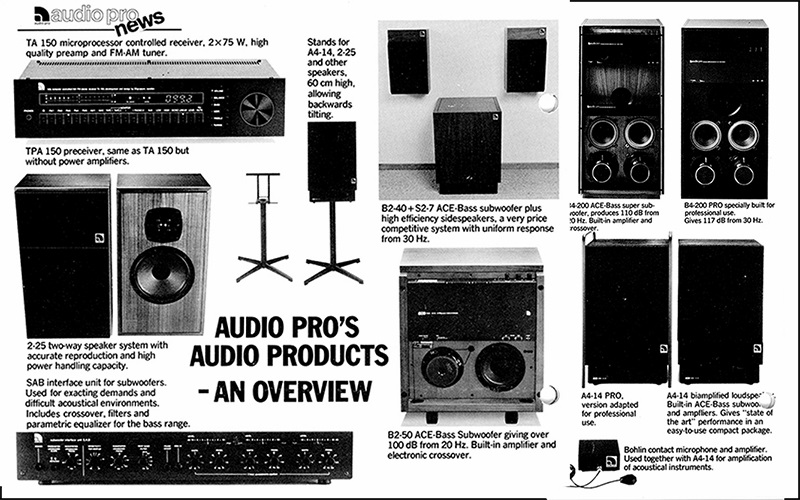
Later, the Swedish company added a subwoofer with four drivers, along with many other interesting solutions. However, the ACE designs are with a bass-reflex enclosure, which uses radiation from the rear of the speaker diaphragm to extend the low-frequency response. Outside the frequency range where the bass reflex port fulfills its intended function, its impact on the speaker system's performance is generally negative. The bass reflex port causes harmful increases in diaphragm excursion below the operating range and parasitic acoustic resonances above the operating range. Furthermore, turbulent noise can arise at the edges of the port. With the possibilities of new technologies, KEF's closed-box solution is more advantageous. There is even an offer without Uni-core, which is much cheaper and will also work well at home. Slim profile subwoofer T2 is for 789 € with 10 in drive and 250W amplifier. For only 649 € is the compact Kube 8 MIE may not take up much space, but the bass it
delivers is far from small. With an 8-inch driver, it is ideally suited
for smaller rooms. By sharing the same 300 Watts Class D amplifier from
it's larger siblings, Kube 8 MIE exhibits unprecedented levels of
control. With Music Integrity Engine®, the Kube 8 MIE is optimised to dynamically extend the bass depth.
With the possibilities of new technologies, KEF's closed-box solution is more advantageous. There is even an offer without Uni-core, which is much cheaper and will also work well at home. Slim profile subwoofer T2 is for 789 € with 10 in drive and 250W amplifier. For only 649 € is the compact Kube 8 MIE may not take up much space, but the bass it
delivers is far from small. With an 8-inch driver, it is ideally suited
for smaller rooms. By sharing the same 300 Watts Class D amplifier from
it's larger siblings, Kube 8 MIE exhibits unprecedented levels of
control. With Music Integrity Engine®, the Kube 8 MIE is optimised to dynamically extend the bass depth.
With the possibilities of new technologies, KEF's closed-box solution is more advantageous. There is even an offer without Uni-core, which is much cheaper and will also work well at home. Slim profile subwoofer T2 is for 789 € with 10 in drive and 250W amplifier. For only 649 € is the compact Kube 8 MIE may not take up much space, but the bass it
delivers is far from small. With an 8-inch driver, it is ideally suited
for smaller rooms. By sharing the same 300 Watts Class D amplifier from
it's larger siblings, Kube 8 MIE exhibits unprecedented levels of
control. With Music Integrity Engine®, the Kube 8 MIE is optimised to dynamically extend the bass depth.
However, music is not only about low tones and KEF has had a good solution with Uni-Q since the 1980s. It's now in its 12th generation of this coaxial electroacoustic transducer solution. A coaxial loudspeaker is a loudspeaker system in which the individual driver units radiate sound from the same point or axis. KEF offers many active speaker models with them, but they have a bass reflex enclosure.
 The bass reflex port is at the back, so they should not be hung on the wall. Theoretically, this can be ignored if they don't handle low frequencies, as the subwoofer does that. However, in practice, it's not that simple. The music signal doesn't flow from the subwoofer to the satellites. Quite the opposite.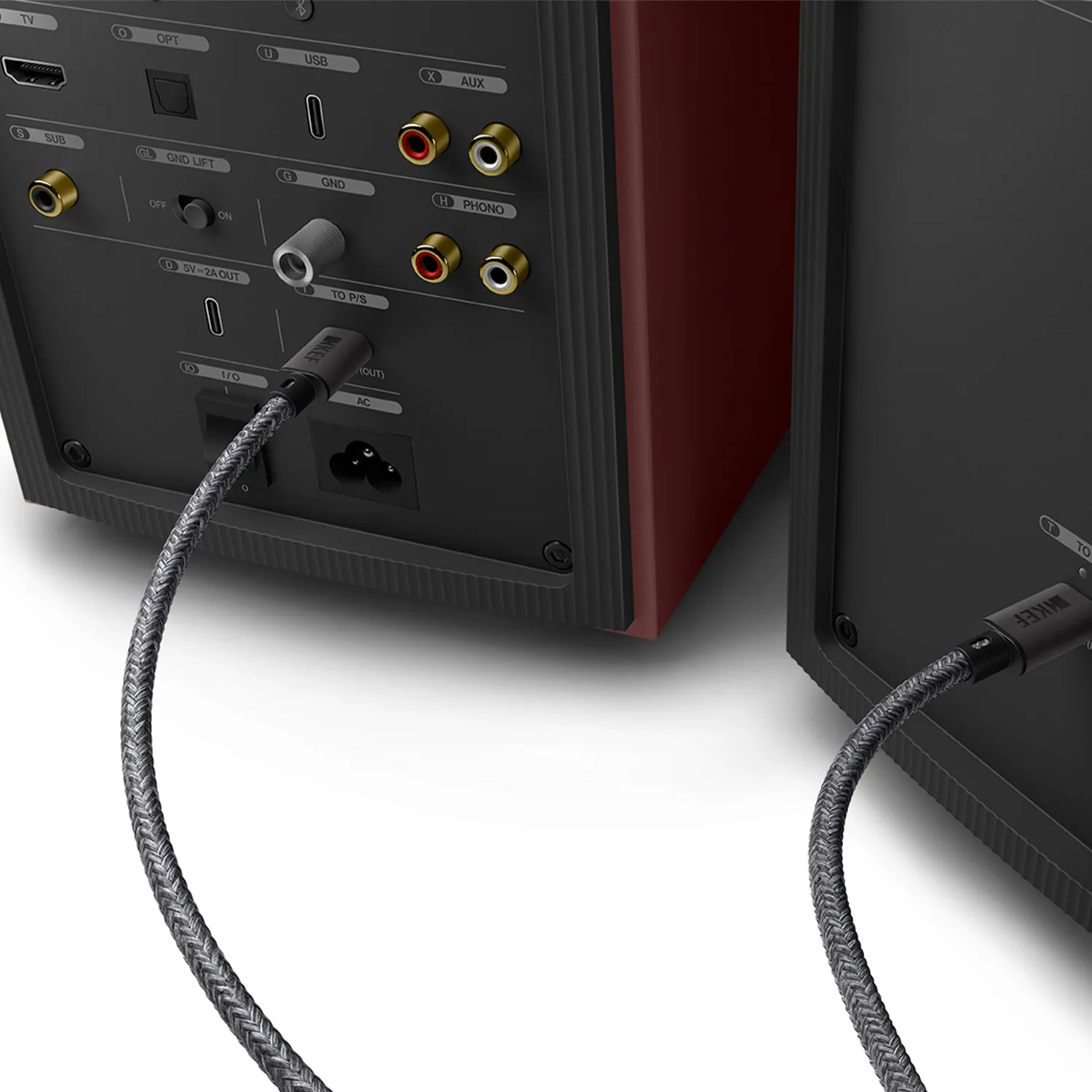
One of the active speakers is also a preamplifier, from which the signal is sent digitally to the other and analogue to the subwoofer. This is the case with. This is the case with the cheapest offer CODA W and can be seen in the illustration above. In more expensive models, analog subwoofer outputs are on both active speakers, where one is the master and the other is a slave with a digital connection. The logic with KEF's offering is completely different than in the 1980s with Swedish designs, as well as with the Polish PA system. While the components are very attractive, they are difficult to adapt to the needs of a traditional stereo and home theater system.
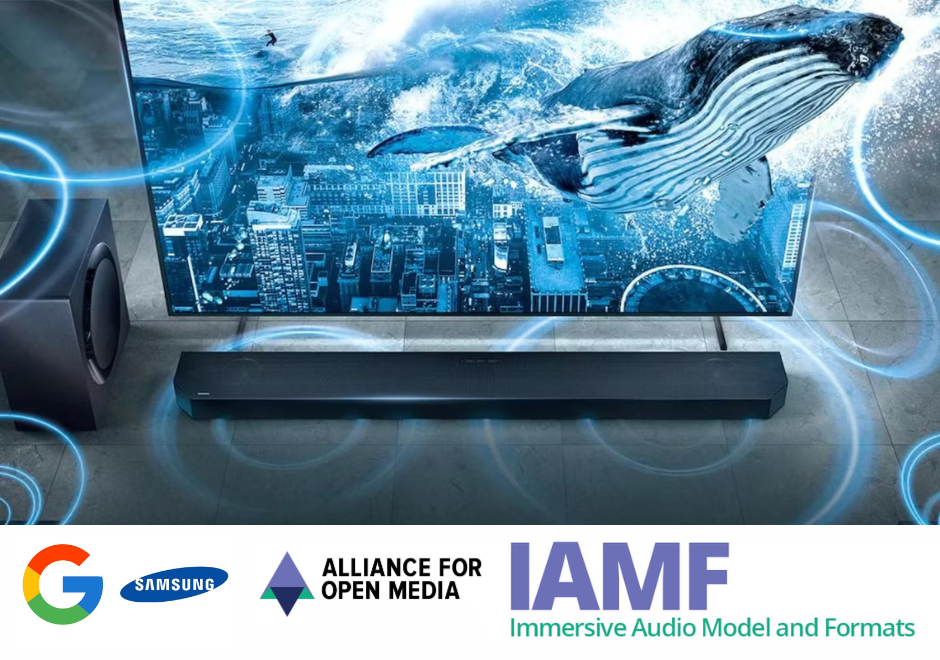
The situation may change with the emergence of a new system. At the Consumer Electronics Show 2025 in Las Vegas, it was presented under the name Eclipsa Audio. From the information provided on this subject, it can be assumed that this is to avoid licensing costs for Dolby Atmos. Much more importantly, the lack of licensing restrictions will greatly simplify development work for hardware manufacturers. In this respect, it is even more important for software developers. Good software will help hardware manufacturers better manage their equipment for spatial playback of stereophonic, quadraphonic and Eclipsa Audio recordings. Dolby recordings will also be played, but not in their original form, which may prove to be a big advantage.
 This will certainly also benefit the equipment manufactured in China with the British brand and its great solutions. This will also make them more useful with PC4uMusic configurations.
drawing by Per Oscar Dahlberg
Benjamin's psychoacoustic lab is
constantly testing and implementing possibilities for optimal music
playback using new technical solutions with the computing potential of
computers and open structures. PC4uMusicis the main project and this blog is just a notebook focused on technical possibilities, not the beauty of words.

KEF has received over 300 awards and holds more than 150 patents. KEF also has published more than 50 academic papers and has received two Queen's Awards for Export Achievement.
ReplyDeletehttps://en.wikipedia.org/wiki/KEF
In 1992, KEF was acquired by Gold Peak Group
Deletea Hong Kong–based multinational corporation which is established in 1964 and has been listed on the Hong Kong Stock Exchange since 1984.
https://en.wikipedia.org/wiki/Gold_Peak
Hong Kong was handed over from the United Kingdom to China in 1997.
Deletehttps://en.wikipedia.org/wiki/Hong_Kong
The USB Power Delivery specification uses one of CC1 or CC2 pins for power negotiation between source device and sink device, up to 20 V at 5 A.
ReplyDeletehttps://en.wikipedia.org/wiki/USB-C#USB_Power_Delivery
The Alliance for Open Media (AOMedia) is a non-profit industry consortium headquartered in Wakefield, Massachusetts, and formed to develop open, royalty-free technology for multimedia delivery.
ReplyDeletehttps://en.wikipedia.org/wiki/Alliance_for_Open_Media
Members
ReplyDeletehttps://aomedia.org/about/members/
CES (formerly an initialism for Consumer Electronics Show) is an annual trade show organized by the Consumer Technology Association (CTA).
ReplyDeleteAt the 1981 CES, Philips and Sony introduced the CD player, which they had developed together.
Microsoft demonstrated a preview version of Windows XP Media Center Edition at CES 2002.
https://en.wikipedia.org/wiki/Consumer_Electronics_Show
The Consumer Technology Association (CTA) is North America's largest standards and technology trade organization representing more than 1,200 technology companies.
Deletehttps://en.wikipedia.org/wiki/Consumer_Technology_Association
The largest gatherings of audio professionals in the world, AES Conventions are held annually in both the United States and Europe.
ReplyDeletehttps://aes.org/event/conventions/
The Audio Engineering Society (AES) is a professional body for engineers, scientists, other individuals with an interest or involvement in the professional audio industry.
Deletehttps://en.wikipedia.org/wiki/Audio_Engineering_Society
On June 18, 2010, Dolby introduced Dolby Surround 7.1, which added two rear surround channels to the 5.1 format.
ReplyDeleteIn April 2012, Dolby introduced Dolby Atmos, a new cinema technology adding overhead sound, first applied in Pixar's motion picture Brave.[15] In the same year, Dolby bought the naming rights of Hollywood's Dolby Theatre, the venue of the annual Academy Awards ceremony.[16] In July 2014, Dolby Laboratories announced plans to bring Atmos to home theater. The first television show to use the technology on disc was Game of Thrones.
In May 2019, Dolby added Dolby Atmos to hundreds of newer songs in the music industry
Dolby Surround, Dolby Pro Logic, Dolby Pro Logic II, Dolby Pro Logic IIx, and Dolby Pro Logic IIz: these decoders expand sound to a greater number of channels. All can decode surround sound that has been matrixed into two channels; some can expand surround sound to a greater number of speakers than the original source material. See the referenced articles for more details on each decoder.
https://en.wikipedia.org/wiki/Dolby